Week 6
- Read the first two chapters of the notes.
Week 6b
- We introduced faster than \(O(n^2)\) multiplication, where \(n=2^k\) is the number of digits, due to Karatsuba;
we got \(O(n^{\log_2 3})\); this is
\(3^k\), which corresponds to the
number of single digit multiplications at the end of the divide and
conquer.
- Although the final answer is correct, in my haste, I think I did not
properly estimate the number of additions/subtractions required. I
should of said that each level \(j\),
we basically have \(3^j\) additions
with numbers that which are of length \(2^{k-j}\), this gives the summation, \[\sum_{j=1}^k 2^{k-j}3^j \leq
3\cdot3^{k}.\]
- We formally introduced the big \(O\) notation and gave a sufficient
condition in terms of limits
- We analysed more carefully the selection sort algorithm.
- We introduced the concept of a loop-invariant
- We wrote some R code for this sorting algorithm
Week 7
- Starting looking at Chapter 3 of the notes.
Week 7a
- We introduced merge sort and discussed why it is \(O(n\log n)\)
- We coded it, but it had a bug; the bug was that v, the second half
the split of x, was wrongly defined. The version done in class will be
posted along with the videos, and a working version is available here.
Week 8
Week 8a
- We discussed stacks, queues, and trees
Week 8b
- We sketched a proof of the Master
theorem, where I fumbled on the third case. I should of wrote:
- The regularity assumption implies that \(f(b^{\ell}) \leq (c/a)^{k-\ell}
f(b^k)\).
- Then \(T(n) = T(b^k) = \Theta(a^k) +
\sum_{\ell=0} ^{k-1} + \Theta(a^k) + a^{k-1-\ell}f(b^\ell) \leq
a^{-1}f(b^k)\sum_{\ell=0} ^{k-1} c^{k-\ell} \leq \Theta(a^k) +
\frac{a^{-1}f(b^k)}{1-c}.\)
- The result that \(T(n) = T(b^k)
=O(f(n))\) now follows, since by assumption \(f(n) = \Omega(n^{\log_b a + \epsilon})\);
it is not much harder to get that it is actually \(\Theta(f(n))\).
- More details in Section 4.6 of the CLRS-Algorithms book.
- We discussed simple uniform hashing.
- We introduced the adjacency matrix for counting walks on
graphs.
Week 9
- Start looking at Chapter 4 of the notes.
Week 9a
- We started a discussion about dynamic programming
- We introduced breadth and depth first search
- We had some A/V issues
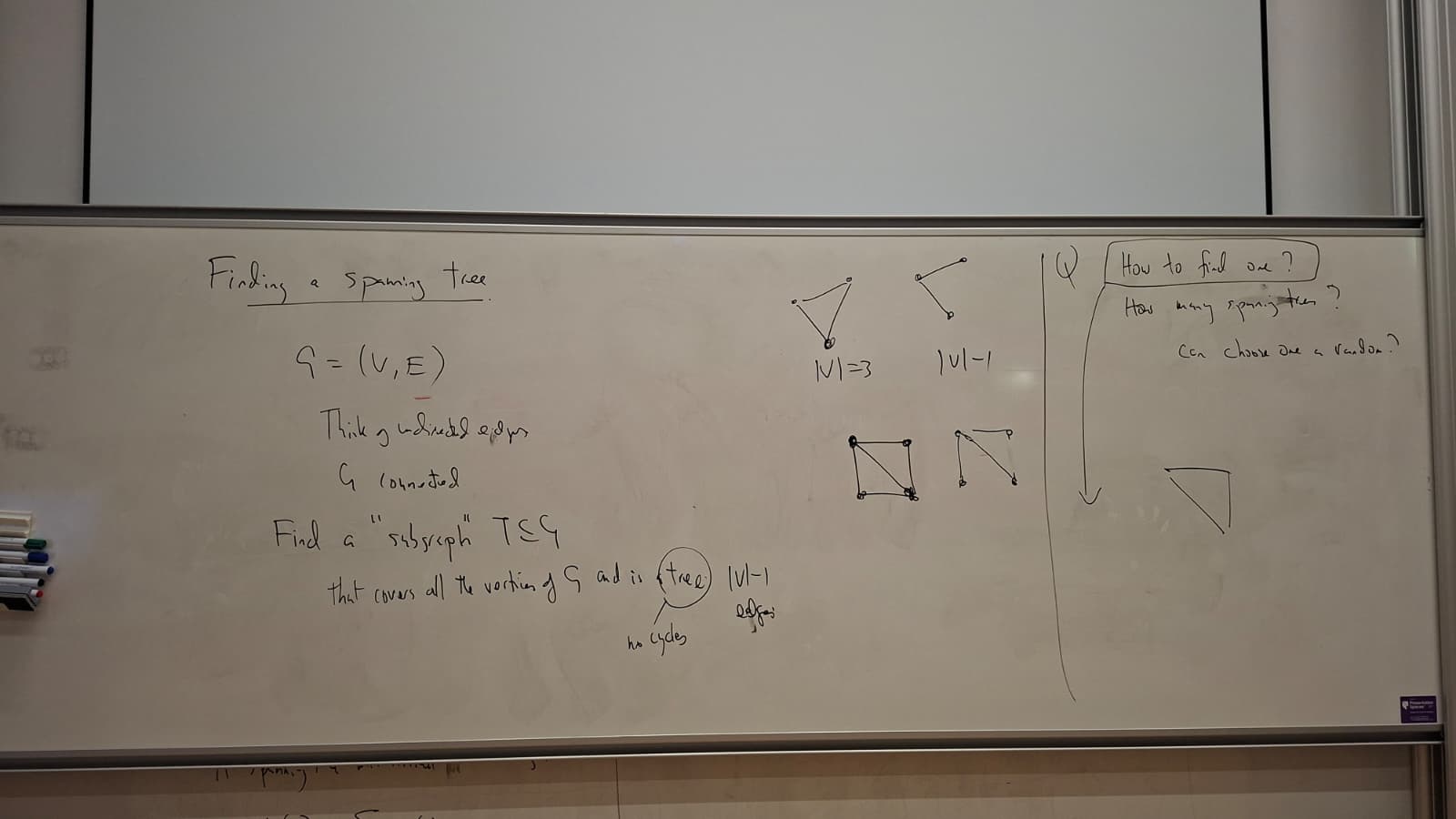
- We introduced spanning trees
Week 9b
- We discussed the notion of a predecessor subgraph in the BFS
algorithm.
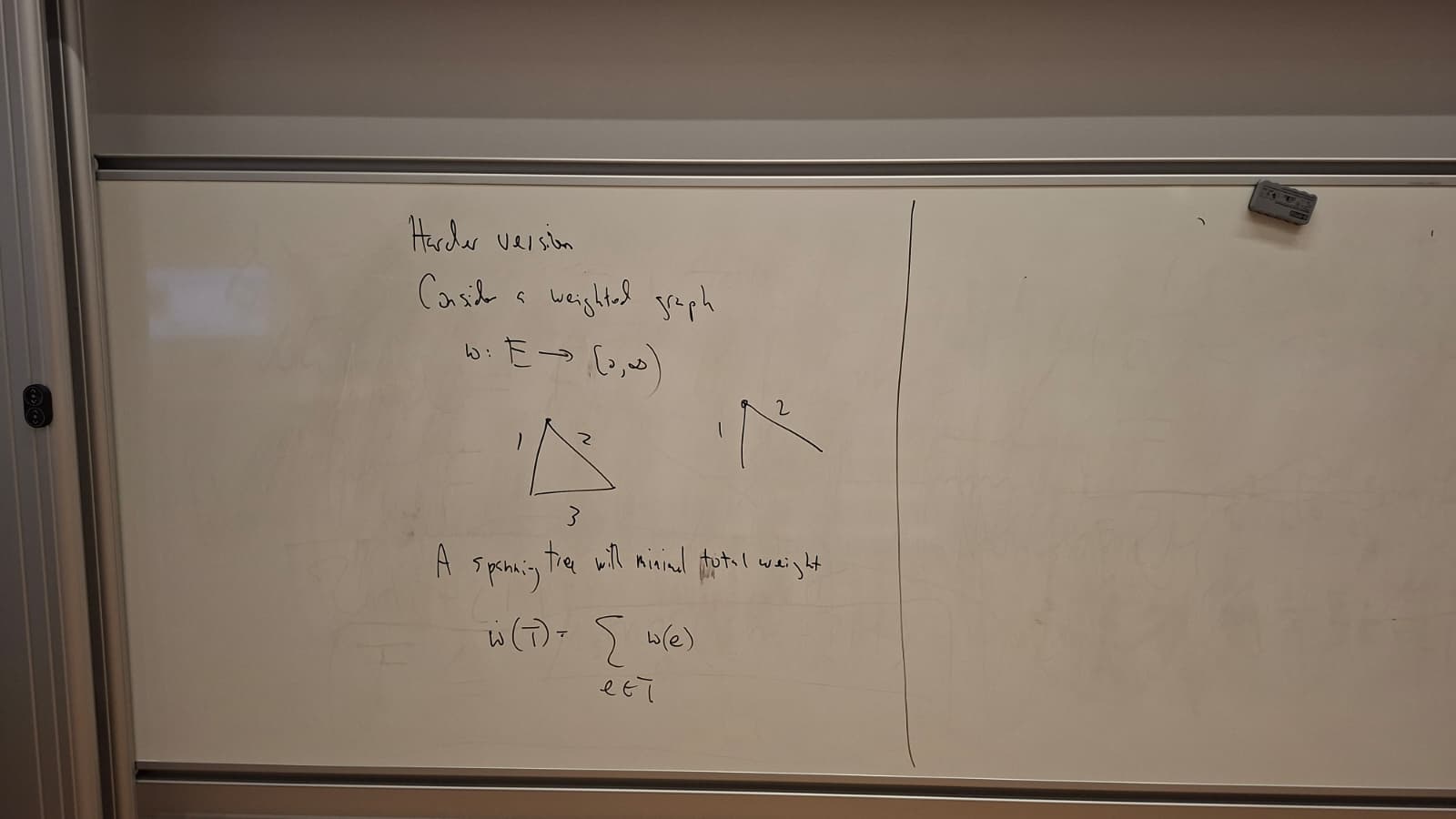
- We introduced the notion of a light edge.
- We discussed Prim’s and Kruskal’s algorithms (CLRS Chapters 22.1,
22.2)
- We introduced the notation of relaxation
- We discussed the Bellman-Ford Algorithm (CLRS, Chapter 24.1)
Week 10
- Read chapter 5 of the notes
Week 10a
- We discussed Dijkstra’s algorithm
- We introduced binary heaps (CLRS, Chapter 6)
Week 10b
- We continued our discussion of heaps and priority queues and their
role in Dijkstra’s algorithm
- We continued our discussion on dynamics programming and the role of
bottom up coding and memoization
Week 12
Week 12a
- Hidden Markov chains and the filtering problem (forward
algorithm)
Version: 08 November 2026